Vanilla Bar: A Playful Font for Creative Branding
When you're building a brand or crafting a project that needs personality, your typography choices carry more weight than most people realize. The right typeface can make a greeting card feel warm and inviting, give a poster an unmistakable energy, or help a children's book capture young imaginations. Vanilla Bar is a premium font designed precisely for these moments—when you want your work to feel approachable, artistic, and memorable without sacrificing professionalism.
What Makes Vanilla Bar Stand Out
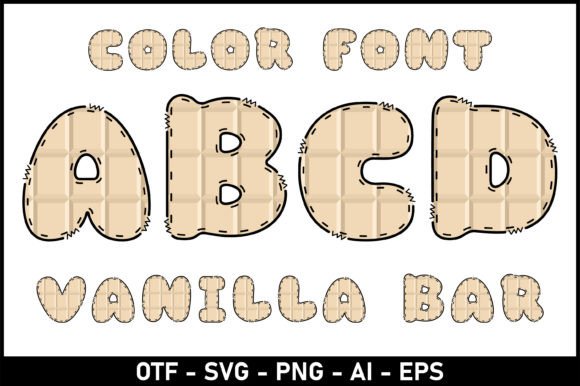
Vanilla Bar belongs to the handwritten font family, but it's not the kind of loose, scratchy script that looks like someone grabbed a marker and rushed through it. Instead, it strikes a thoughtful balance between organic warmth and polished execution. The letterforms have a gentle, rounded quality with subtle variations that mimic natural hand movement, giving text a human touch that rigid sans serif fonts simply can't replicate.
What I appreciate about this creative font is its versatility in tone. Depending on how you use it, Vanilla Bar can read as whimsical, sophisticated, casual, or even editorial. It doesn't box you into a single aesthetic. The curves are fluid without being overly decorative, and the spacing feels intentional—neither cramped nor airy. This kind of design awareness is what separates a well-crafted display font from one that looks like an afterthought.
The font comes in both a black version and a color version, which opens up interesting creative possibilities. The black version works like any standard typeface and is fully compatible with Cricut Design Space and other cutting machines—something crafters and small business owners making physical products will find genuinely useful. The color version, however, is where things get more experimental. It's designed for programs like Photoshop, Illustrator, Silhouette, and Inkscape, letting you work with multi-tonal lettering directly in your designs.
Where Vanilla Bar Truly Shines
I've seen fonts like Vanilla Bar work beautifully across a surprisingly wide range of projects. Let me walk through some of the most effective applications based on real-world use cases.
Children's books and educational materials are a natural fit. The playful, rounded letterforms are easy for young readers to recognize, and the overall personality of the typeface supports the kind of engaging, colorful storytelling that keeps kids turning pages. If you're a self-publishing author or working with a small press, using Vanilla Bar for chapter titles, pull quotes, or cover lettering can give your book a distinctive look that stands out on shelves and in thumbnail previews online.
Branding and logo design benefit from Vanilla Bar's approachable character. For businesses that want to project warmth—a bakery, a boutique studio, a lifestyle blog, a children's clothing line—this font communicates friendliness and creativity without looking unprofessional. It works particularly well for brands targeting audiences who value authenticity and handmade aesthetics. Think about the difference between a sterile corporate logo and one that feels like it was crafted with care. Vanilla Bar leans firmly into the latter.
Packaging design and product labels are another strong application. Small business owners selling handmade goods, artisanal products, or specialty items often struggle with typography that either feels too generic or too chaotic. Vanilla Bar occupies a sweet spot: distinctive enough to differentiate your product on a crowded shelf, clean enough to remain legible at smaller sizes.
Social media graphics and digital content benefit from the font's visual energy. In a feed full of predictable, templated text, something with genuine personality catches the eye. Use Vanilla Bar for Instagram quotes, story highlights, Pinterest pins, or YouTube thumbnails. It photographs well and maintains its character even when reduced to smaller sizes on mobile screens—though you'll want to test this carefully, as I'll discuss below.
Invitations, greeting cards, and stationery are perhaps where Vanilla Bar feels most at home. The handwritten quality lends itself naturally to personal, celebratory contexts. Wedding invitations, birthday cards, baby shower announcements, holiday greetings—these are projects where warmth and personality are non-negotiable, and Vanilla Bar delivers both.
Poster design and editorial layouts can also leverage this typeface effectively, especially for headlines, drop caps, or accent text. Pairing it with a clean sans serif font for body copy creates a dynamic visual hierarchy that draws readers in while maintaining readability across longer passages.
Practical Considerations Before You Commit
Choosing any premium font for a project deserves careful thought, and Vanilla Bar is no exception. Here are some grounded recommendations based on how professional designers and content creators actually work.
Test readability in context. Handwritten fonts, even well-designed ones, can lose clarity at very small sizes or in dense paragraphs. Use Vanilla Bar primarily as a display font for headlines, titles, short phrases, and accent text rather than body copy. For longer reading passages, pair it with a legible serif font or sans serif font that handles sustained reading comfortably.
Experiment with font pairings. Vanilla Bar's personality is strong, so it pairs best with typefaces that complement rather than compete. A geometric sans serif provides clean contrast. A traditional serif adds sophistication. Avoid pairing it with other expressive or decorative fonts, as the combination tends to feel cluttered and confusing. The goal is visual harmony—each typeface should have a distinct role.
Understand the file formats and compatibility. This is where many people stumble. The black version of Vanilla Bar includes standard OTF and TTF files that work across virtually all design software and cutting machines. The color version is more specialized. It's compatible with Photoshop, Illustrator, Silhouette Studio, and Inkscape, but it will not work in Cricut Design Space. If you're a crafter who relies on Cricut, stick with the black version and add color manually through your machine's software. If you want more detailed guidance on working with color fonts, the Ultimate Font Guide covers this thoroughly.
Review what's included. Before purchasing any commercial font, check exactly what you're getting. Look at the character set—does it include uppercase, lowercase, numerals, punctuation, and multilingual support? Does it offer stylistic alternates or ligatures? These details matter when you're working on professional projects that require flexibility.
Clarify the licensing terms. If you're using Vanilla Bar for client work, merchandise, digital products, or anything commercial, make sure the license covers your intended use. Most reputable font designers offer clear licensing information, and it's worth reading the fine print before you build an entire brand identity around a typeface you might need to replace later.
Building a Consistent Visual Identity
One of the most overlooked aspects of modern typography is consistency. When you select a font like Vanilla Bar for a project, commit to it across touchpoints. Use it on your website headers, your social media templates, your printed materials, your email signatures—everywhere your audience encounters your brand. This repetition builds recognition. Over time, people begin associating that specific lettering style with your work, which is exactly how strong brand identity takes shape.
Vanilla Bar offers enough versatility to maintain interest within that consistency. The included styles and character variations let you create subtle differences between applications while keeping the overall voice cohesive. A product label might use a slightly different weight than a social media post, but both feel unmistakably like the same brand.
For designers, entrepreneurs, bloggers, and creators who need a creative font that bridges the gap between playful and professional, Vanilla Bar deserves serious consideration. It won't work for every project—no single typeface does—but in the right context, it elevates your work from generic to genuinely distinctive. Take the time to test it within your specific projects, evaluate how it reads at the sizes you'll actually use, and pair it thoughtfully. The results will speak for themselves.