Why the School Day Font Brings Instant Personality to Your Work
There’s a particular challenge in design when you need to communicate something without using words. You want to say, “This is fun. This is approachable. This is for kids,” or at least for the young at heart. You could rely on imagery, but often, the first thing a viewer sees is the typography. That’s where a typeface like School Day earns its place in your toolkit. It’s not just a display font; it’s a personality transplant for your layout.
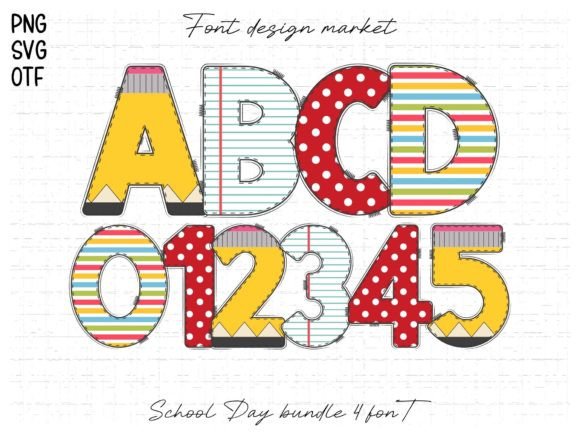
Visually, School Day is a chunky lettered font that leans heavily into nostalgia without feeling outdated. It features rounded terminals and slightly uneven baselines, mimicking the authentic imperfection of a child’s handwriting or a teacher’s friendly chalkboard script. It avoids the jagged edges of some handwritten font styles, opting instead for a softer, more inclusive aesthetic. This makes it a cute and fun color font that feels genuinely playful rather than forced.
Injecting Authenticity into Brand Identity
For entrepreneurs and brand strategists, font choice is about perception. If you are building a brand identity for a daycare, a pediatric dentist, a toy store, or a family-friendly bakery, you need a typeface that puts parents at ease while signaling joy to children. School Day bridges that gap perfectly. It doesn't look like a generic sans serif font trying to be friendly; it actually embodies that playfulness.
When used in logo design, this typeface acts as an immediate visual shorthand. It tells the customer exactly what kind of experience they are signing up for before they read a single line of body copy. However, a word of caution from a professional standpoint: because School Day is so expressive, it commands attention. It works best as the primary typeface for headers and logos, but it should rarely be used for long-form paragraphs. You need the energy of School Day to punctuate your design, not tire the reader’s eyes.
Practical Applications: From Screen to Print
The versatility of a premium font lies in how well it adapts to different mediums. School Day shines across a variety of contexts, particularly where visual hierarchy is needed to draw the eye to a specific call to action or headline.
- Digital and Social Media: In the fast-scrolling world of social media, you have about two seconds to grab attention. Using School Day for text overlays on Instagram Reels or YouTube thumbnails can significantly boost engagement. Its chunky weight ensures readability even on small mobile screens, making it a great choice for social media graphics.
- Publishing and Editorial Design: If you are working on editorial design for a parenting magazine or a children's book cover, this font sets the tone immediately. It pairs surprisingly well with clean serif font styles. Try using School Day for the main headline and a classic serif for the subheading to create a sophisticated yet approachable contrast.
- Packaging Design: Think about the shelf appeal of a juice box or a box of crayons. Packaging design for children's products relies heavily on bright colors and friendly type. School Day offers the kind of tactile, 3D quality that makes products look physical and touchable.
- Web Design: While you wouldn't use it for your navigation menu, incorporating this creative font into specific landing pages for back-to-school sales or summer camp registrations can make the user experience feel more thematic and immersive.
Technical Guidance and Font Pairing
Adopting a new typeface into your workflow requires more than just liking how it looks; it requires testing. When evaluating School Day for a project, consider the following practical steps to ensure professionalism and consistency.
First, look at the font pairing. Because School Day is a display font with high personality, it needs a grounding partner. A geometric sans serif font often works best here. The clean lines of the sans serif will not compete with the playful curves of School Day, allowing the headline to remain the star of the show. Avoid pairing it with other script font or handwritten font styles, as this can create visual chaos and reduce readability.
Second, check the included styles. A robust typeface family often includes various weights or alternates. Does School Day come with different glyphs that allow you to swap out a letter "a" or "g" to make the text look more natural? Using these alternates is a hallmark of good typography and helps avoid the "cookie-cutter" look where every repeated letter is identical.
Finally, verify the commercial font licensing. If you are a small business owner or a crafter selling goods on Etsy, you need to ensure your design assets are cleared for commercial use. Most reputable font marketplaces are transparent about this, but always double-check the EULA (End User License Agreement) before putting the font on a product you intend to sell.
The Impact on Audience Engagement
Ultimately, the goal of any design asset is connection. Modern typography trends often favor minimalism, but there is a growing counter-movement toward warmth and humanity. School Day taps into that need for connection. It feels handmade and authentic in a digital world that can often feel cold.
By utilizing a typeface that carries such a specific emotional weight, you are doing half the marketing work for your client. You are establishing a mood that invites participation. Whether you are a blogger designing a printable worksheet or a marketer creating a banner for a family event, School Day provides the scaffolding for a design that doesn't just look good—it feels right. It brings your designs to life by reminding the viewer of the simple joy of learning and playing.